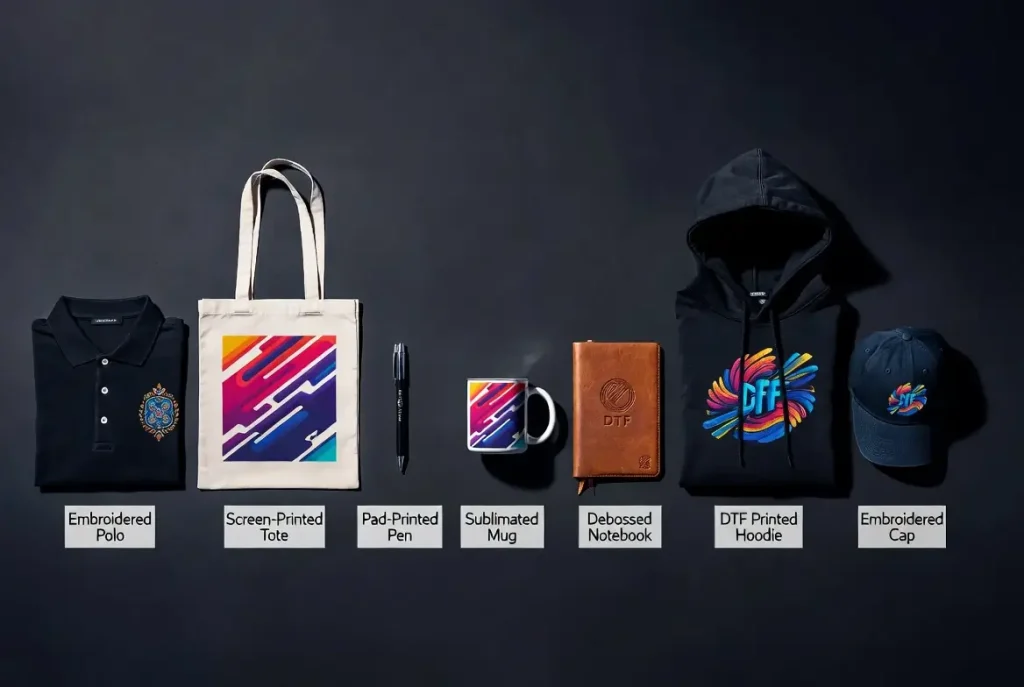
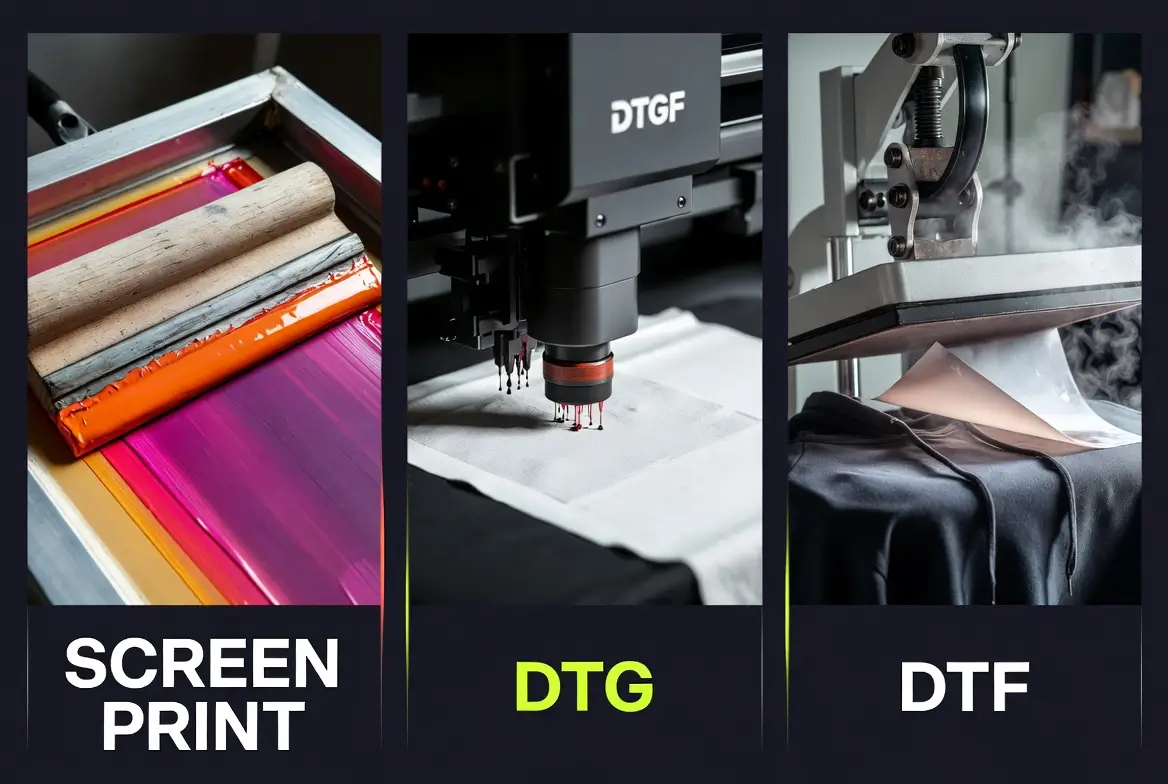
Ordering branded t-shirts, hoodies, or apparel? One of the most common questions we get at PromoLink is: what’s the difference between screen printing, DTG, and DTF — and which one should I use?
They all print designs onto garments, but they work very differently and are suited to different jobs. Here’s the definitive comparison to help you choose.
The Quick Summary
| SCREEN PRINT | DTG | DTF | |
| Best For | High volume, simple designs | Small runs, full colour | Any run size, complex artwork |
| Min. Quantity | Usually 12–24+ units | 1+ units | 1+ units |
| Colour Complexity | Limited (cost per colour) | Unlimited | Unlimited |
| Durability | Excellent | Good (on 100% cotton) | Very Good |
| Fabric Types | Most fabrics | 100% cotton preferred | Most fabrics |
| Cost per Unit (High Vol.) | Low | Higher | Low-Medium |
| Cost per Unit (Low Vol.) | Higher (setup costs) | Low | Low |
| Photographic Detail | No | Yes | Yes |
| Feel on Garment | Smooth (well-applied) | Slightly textured | Slight texture/hand |
Screen Printing: The Workhorse of Garment Decoration
Screen printing has been the industry standard for branded apparel for decades — and for good reason. When you need a large run of t-shirts with a clean, consistent logo, screen printing is almost always the most cost-effective option.
How it works
A mesh screen is created for each colour in your design. Ink is pushed through the screen onto the garment. Each colour is applied separately, one layer at a time. The inks are cured by going through a heat tunnel to set permanently.
Screen print pros
- Extremely durable — prints should last the life of the garment. When cared for properly
- Very cost-effective at medium to high volumes (50+ units)
- Vibrant, solid colours, bold branding — especially on dark garments
- Works on a wide range of garment types
Screen print cons
- Setup cost per size / colour / design makes it less economical for small runs or complex multi-colour designs
- Not suitable for photographic imagery or fine gradients
- Minimum quantities apply (MOQ 25)
Screen print is ideal for
Event t-shirts, uniforms, giveaways, bulk branded tees, fundraising merchandise, and any situation where you’re ordering 50+ pieces with a simple 1–5 colour design.
DTG (Direct to Garment): The Small-Run, Full-Colour Solution
DTG prints directly onto the garment using a modified inkjet printer. Think of it like printing paper, but on fabric. You can replicate photographic images, complex gradients, and highly detailed artwork with no setup costs per colour.
How it works
The garment is pre-treated (especially important for dark garments), then fed into the DTG printer. The machine prints your design directly onto the fabric using water-based inks. The print is cured with heat.
DTG pros
- No setup costs per colour — great for single units and very small runs
- Unlimited colours — photographic detail, gradients, no problem
- No minimum order quantity
DTG cons
- Works best on 100% cotton — performance fabrics and synthetics don’t take the print as well
- More expensive per unit at higher quantities than screen print
- Dark garment printing requires a white base and can affect vibrancy
- Care instructions are more crucial to follow — harsh detergents reduce longevity
DTG is ideal for
Custom one-off gifts, sample runs, personalised merch, full-colour artwork on cotton, and any situation where you need a small quantity without high setup fees.
DTF (Direct to Film): The Versatile All-Rounder
DTF is one of the newer decoration methods to emerge in recent years and it’s quickly become a fan favourite for its versatility and simplicity. The design is printed onto a special transfer film and then heat-pressed onto the garment using a commercial heat press. This means it can work on almost any fabric type.
How it works
Your design is printed in full colour onto a PET film with white underbase to maintain colour vibrancy. An adhesive powder is applied and the transfers cured. The film is then heat-pressed onto the garment, bonding the design to the fabric.
DTF pros
- Works on almost any fabric — cotton, polyester, blends, nylon, and more
- Full colour, no colour restrictions
- Cost-effective for small to medium runs
- Highly detailed reproduction including gradients and fine lines
- No pre-treatment required
DTF cons
- Slight texture/hand feel to the print (transfer)
- Not quite as durable as screen print
DTF is ideal for
Mixed fabric orders, smaller runs with complex artwork, polyester or blend garments, sports apparel, and businesses that want quality full-colour printing without the high minimums of screen print.
So, Which Should You Choose?
Here’s our quick decision guide:
- Ordering 50+ pieces with a simple logo? — Screen Print
- Need full-colour artwork on 100% cotton in small quantities? — DTG
- Got complex artwork across mixed fabric types? — DTF
- Want a premium feel on corporate or event apparel? — Embroidery
Still Not Sure? We’ll Figure It Out For You.
This is what we do every day. Whether you’ve got a clear brief or you’re starting from scratch, the PromoLink team will assess your artwork, your quantities, your fabric, and your budget, and give you a straight recommendation. No jargon, no upselling — just honest advice.
Call us: (03) 9855 1108